
How to Check Criminal History in Middlesex County
Begin with the event you want to confirm. A filed charge belongs in Virginia's court system. Present custody belongs with the regional jail, while a final court outcome belongs in the clerk's file. A police narrative remains with the agency that wrote it. One search can miss a valid record because these custodians answer different questions. Middlesex County felony matters can also appear first in General District Court and later in Circuit Court. Compare case numbers, dates, and transfer language before deciding that two entries describe two separate events.
Have the full legal name, spelling variants, an approximate date, and a case or incident number when possible. A date of birth can help an office separate common names, though public displays may limit that field. Use this sequence for a focused Middlesex County criminal history check:
- Select Middlesex and the right court level in Virginia Court Case Information.
- Compare the charge, hearing date, case number, and disposition across possible matches.
- Call the jail when the issue is present custody, or the arresting agency for its own report.
- Ask the clerk for the final order or a certified copy when the online index lacks documents.
- Use the notarized SP-167 process for a consolidated Virginia history tied to the subject.
Note: A name match is a lead, not proof that the record belongs to the person being researched.
Middlesex Criminal Records Start in Saluda
The key local counter is at the Middlesex County Courthouse, 73 Bowden Street, Saluda, Virginia 23149. Circuit Clerk Rachel K. Hartenbach keeps felony trial files, grand-jury matters, sentencing orders, and district-court appeals. The clerk's public hours are 8:00 a.m. to 4:00 p.m., and the office phone is (804) 758-5317. General District and Juvenile and Domestic Relations hearings also occur at the Saluda courthouse, although their administrative contact pages may route through Gloucester. Confirm the court level before requesting a Middlesex County criminal case file.
The official Middlesex County government directory helps identify the local office before a visit. Its page is shown below as a practical starting point for local criminal record contacts.

The county directory does not replace the court clerk. It helps route an inquiry to the office that actually holds the requested Middlesex County record.
Middlesex Circuit Court Clerk
73 Bowden Street
Saluda, VA 23149
(804) 758-5317
Public counter: 8:00 a.m. to 4:00 p.m.
Middle Peninsula Regional Security Center
170 Oakes Landing Road
Saluda, VA 23149
(804) 758-2338
Custody and booking questions
Official Virginia Background Checks
Virginia Department of State Police CARE, which incorporates the Central Criminal Records Exchange, provides the SP-167 public criminal record check. The official SP-167 instructions define the mailed self-review process and result terms. It is not an instant results portal. The online generator creates a form that must be printed, signed by the person searched, notarized, and mailed. A second notarized signature is needed when the result will go to someone else. VSP materials list $15 for criminal history alone and $20 for a combined criminal-history and sex-offender search. Optional remote online notarization adds $25.
The VSP criminal background instructions set out the official request route and explain the mail process. The captured instructions below help distinguish the state product from an ordinary Middlesex County court search.
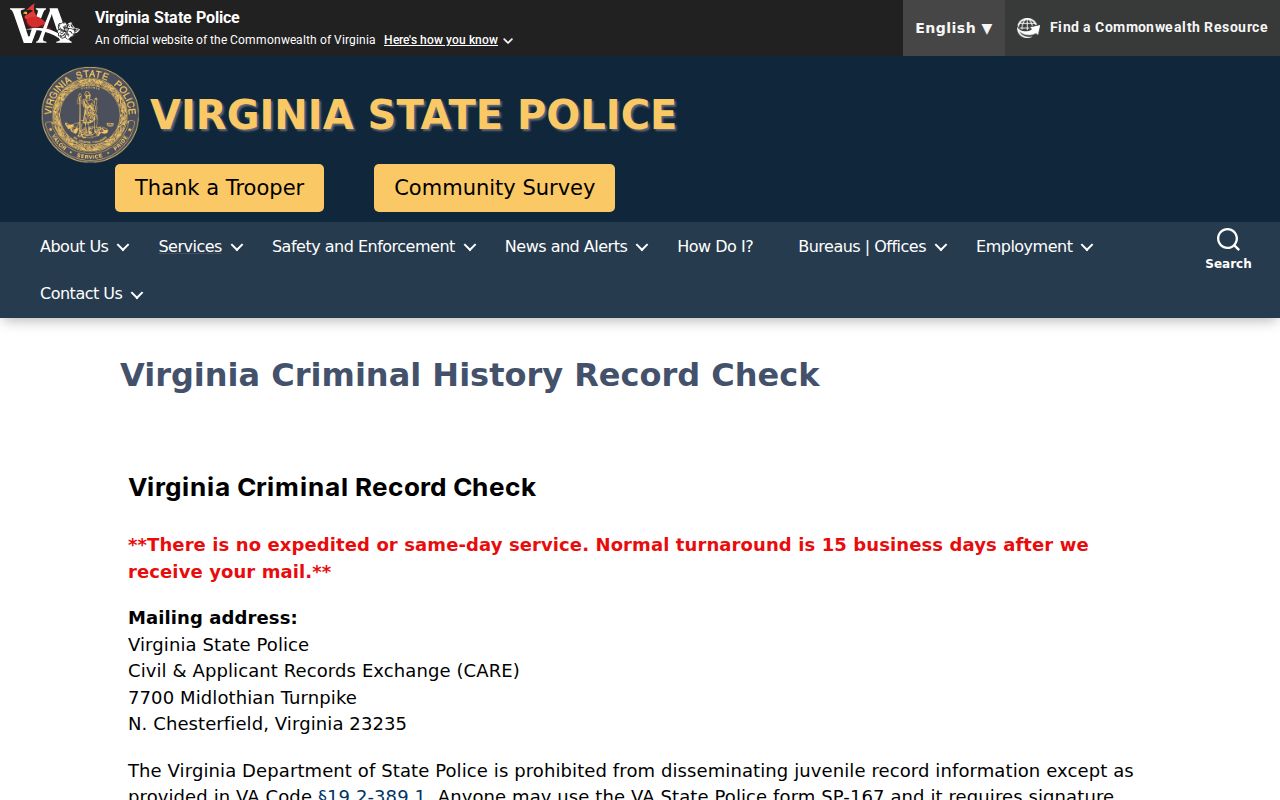
An SP-167 response may say that no record was found or attach a Virginia history. Allow about 15 business days after receipt, with some VSP material giving a 15 to 20 business-day range. There is no same-day option.
| Official product | Published amount | Core requirement |
|---|---|---|
| SP-167 criminal history | $15 | Subject's notarized signature and mail request |
| Combined history and registry search | $20 | Use the VSP form route |
| Remote online notary option | $25 extra | Select it in the generator |
| Authorized state and FBI fingerprint search | $27 total | Statutory authority and approved capture route |
Middlesex SP-167 Record Requests
The SP-167 public generator asks for more than a name. Its route begins with a form choice and whether remote online notarization will be used. Subject fields include first and last name, optional middle or maiden name, suffix, race, sex, and date of birth. Social Security number appears as optional and should not be supplied casually. Mailing fields identify who receives the response. Request type, purpose, country, payment method, and account details appear when relevant.
The VSP forms directory links the record-check and other official forms. The directory image below shows why a requester should use a current state form rather than an old saved copy.
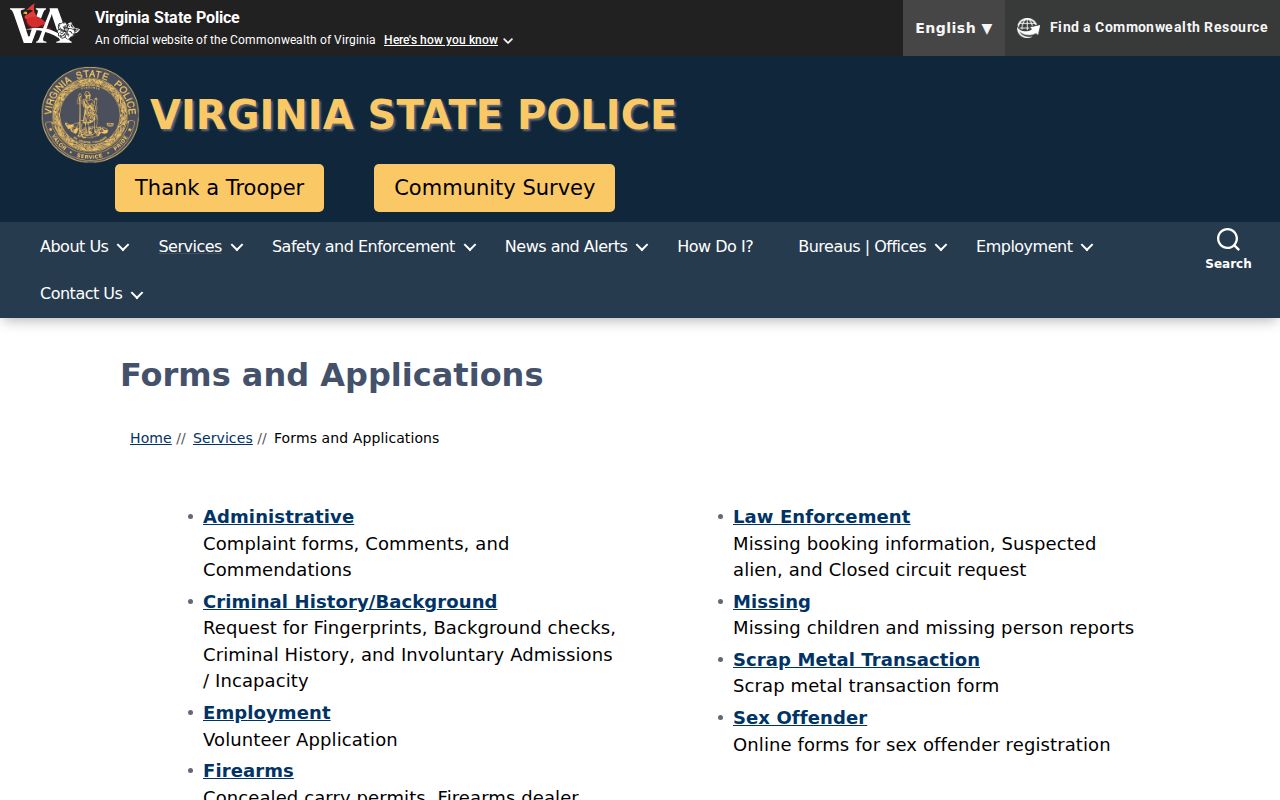
The generator's submit step produces paperwork, not a record on screen. Middlesex County residents should review every identity and mailing field before notarization because a spelling error can delay matching or delivery.
| Field group | What to enter | Why it matters |
|---|---|---|
| Form and purpose | SP-167 and the stated request purpose | Controls the correct workflow |
| Subject identity | Legal name, DOB, race, and sex | Reduces false name matches |
| Recipient | Name and complete mailing address | Sets notarization and delivery rules |
| Payment | Method or authorized account number | Allows VSP to process the mailed form |
Types of Criminal Records
A Middlesex County incident report records what an investigating agency documented and can exist without an arrest. An arrest record describes custody and the charges asserted at that point. MPRSC then creates a separate booking file. A magistrate creates warrant, summons, probable-cause, and initial bail records. Court clerks create dockets and case files. VSP CARE connects reportable fingerprint-based arrest cycles to dispositions that courts later submit. Each product has its own scope and access rule.
The type of court also matters. General District Court resolves adult misdemeanors and conducts felony preliminary hearings. Circuit Court receives felony indictments, trials, sentencing, and district appeals. J&DR handles juvenile matters and certain adult offenses tied to family or minors, with stronger access limits. Other records answer still different questions:
- Booking record: intake, listed charges, bond, custody, and release data held by MPRSC.
- Court case file: pleadings, hearings, judgment, sentence, and financial obligations held by the clerk.
- Virginia history: state-linked arrest cycles and reported outcomes supplied through SP-167.
- Supervision record: state prison, probation, or parole status shown through VADOC.
- Registry profile: the separate public record maintained under Virginia registry law.
Virginia classifies felonies in six classes and misdemeanors in four. The charge's exact Code section controls, not the class label alone. Class 5 and Class 6 felony statutes can permit a shorter jail term and fine at the court or jury's discretion, while unclassified offenses carry the penalty written into their own statutes. A filed charge is still not the outcome. Read the final Middlesex County order for the offense of conviction, sentence, suspended time, and later appeal.
Middlesex Regional Jail Records
Middlesex County does not operate a stand-alone county jail. Local defendants commonly go to Middle Peninsula Regional Security Center, a 121-rated-capacity facility shared by Essex, King and Queen, King William, Middlesex, and Mathews. A search limited to the phrase “Middlesex County jail roster” may therefore miss the real custodian. No reliable public MPRSC roster was verified during the August 10, 2026 research inspection.
For current custody, call (804) 758-2338 or use the weekday visitor lobby from 8:00 a.m. to 4:00 p.m., excluding observed state and federal holidays. A focused request can address historical booking material. For a person later transferred into state custody or supervision, use the VADOC Inmate and Supervisee Locator. VADOC runs felony probation and parole, while a regional community-corrections program serves Gloucester, Mathews, and Middlesex for eligible local-level cases. The locator updates daily, so it is not a real-time substitute for the jail call or the court's supervision order.
Custody is not disposition. A jail response can confirm where someone is held, but the clerk's final order shows what happened to the charge.
Note: The lack of a current jail entry does not show that no arrest occurred; release, transfer, or a noncustodial process may explain the gap.
What a Middlesex County Criminal Record Shows
The fields depend on the record. A Virginia repository history can connect identifiers, arrest dates, arresting agencies, fingerprint transactions, charges, and court-reported dispositions. A public court index can show the court, case number, defendant name, charge, statute, hearings, plea, result, sentence, costs, and appeal details when those fields are public. It does not promise downloadable pleadings. Older documents and certified final orders often require clerk help.
Read charge history as a sequence. The officer's arrest charge is an allegation. A prosecutor can amend, replace, or decline it. A grand jury can indict on a different charge, and the court's judgment controls the final result. These common fields should never be treated as interchangeable:
| Name & Identifiers | Names, aliases, birth data, and system numbers used to distinguish the subject. |
|---|---|
| Arrest / Booking Data | Date, agency, intake, facility, bond, and release details that may be publicly releasable. |
| Charges & Statutes | Alleged offense text and Virginia Code sections at the recorded stage. |
| Disposition | Plea, dismissal, acquittal, nolle prosequi, conviction, or transfer status. |
| Sentence | Confinement, suspended time, probation, fines, and costs ordered by the court. |
| Custody / Supervision | Current jail, prison, probation, or parole status in the system being searched. |
Middlesex Arrest Records Reach CCRE
An arresting deputy, trooper, or authorized town officer first writes the incident and arrest material. When a reportable arrest is booked, qualifying fingerprints and charges flow through the VSP Criminal Justice Information Services division to the Central Criminal Records Exchange. The magistrate's process and bail ruling remain separate judicial records. If charges are filed, the clerk creates the case. The clerk later reports the disposition so the repository can connect the outcome to the arrest cycle.
Local record flow: Arresting agency › MPRSC booking › General District or J&DR proceedings › Circuit Court when a felony advances › CCRE disposition match.
A missing link can make a Middlesex County criminal record look unfinished. A spelling variance, reporting delay, amended charge, or unmatched transaction can separate the final order from the arrest entry. The best correction path is evidence-based: obtain the clerk's final order, compare it with the SP-167 response and agency report, then contact the office responsible for the wrong item. Do not assume that an entry will disappear on its own.
Public Access Laws
Virginia Freedom of Information Act rules govern many county and law-enforcement records, but court files follow the clerk-access framework. Virginia citizens and qualifying media may request public-body records, and an office can ask for a legal address to confirm eligibility. A public body generally must respond within five working days by producing records, citing a withholding basis, saying the record cannot be found, or invoking added time when production is not practical.
Criminal investigative material receives special treatment. Basic incident information can be available while active methods, confidential sources, victim-sensitive media, juvenile material, and safety information remain restricted. State criminal-history dissemination has its own limits. The core laws include:
Key Statutes:
Virginia Freedom of Information Act sets the policy and process for public-body records.
Virginia Code § 2.2-3706.1 addresses criminal incident and investigative information.
Virginia Code § 17.1-208 governs clerk inspection and copying of court records.
Virginia Code § 19.2-389 controls dissemination of state criminal-history information.
Middlesex Criminal Record Requests
Middlesex County has separate routes for county administrative files and Sheriff's Office records. The Sheriff's policy names d.tate@co.middlesex.va.us as the designated contact. A request does not need a special form or the word “FOIA,” but writing down the record type, creator, incident or case number, date range, location, and preferred format makes the scope clear. FOIA provides existing records. It does not require an office to answer questions or create a new criminal-history compilation.
The Middlesex County FOIA page explains request routes, response choices, and cost rules. Its captured page below is tied to county and Sheriff requests, not judicial case files.
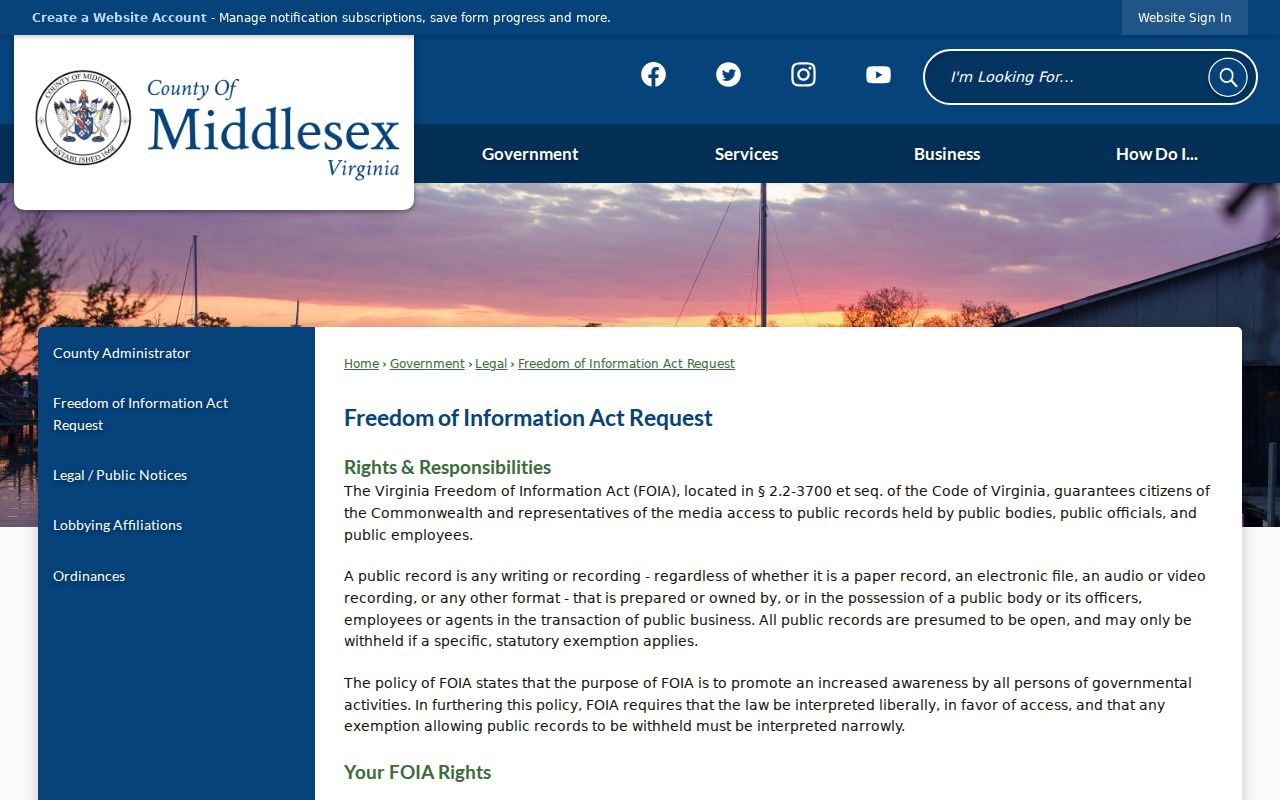
Reasonable actual search and copying costs may apply. Ask for a written estimate and set a ceiling. An advance deposit may be required when the estimate exceeds $200. If part of a record is withheld, ask the office to identify the subject and volume withheld and cite the specific authority.
Sealed, Expunged & Restricted
Juvenile files are not ordinary public adult records. Victim identities, Social Security numbers, financial account data, sealed matters, and protected investigative details can also be withheld or redacted. Under the law in effect on the research date, a person may petition for expungement after an acquittal, nolle prosequi, other qualifying dismissal, or mistaken identity. Middlesex County petitions are filed with the Circuit Court clerk when the local court disposed of the charge.
The petition identifies the charge and result, the name used at arrest, birth date, arrest date and agency when known, and supporting charging papers when reasonably available. The Commonwealth's Attorney is served and can object or state no objection within 21 days. Certain petitioners must submit fingerprints. No filing fees or costs apply to the specified non-conviction and mistaken-identity petitions. An order leads the clerk to notify VSP, but expungement should not be described as universal physical destruction.
Virginia's broader sealing provisions change on December 1, 2026. Any advice published after that date must be checked against the then-effective version of Chapter 23.2. A prior summary is not enough.
Middlesex Warrant Record Fallbacks
No official public Middlesex County active-warrant database was verified as of August 10, 2026. A warrant may begin with a magistrate or court. The Sheriff executes criminal process, while a bench warrant or capias can appear in the public portion of the related court file. Unserved or sealed process may be absent from public dockets. Likewise, law-enforcement systems such as VCIN and NCIC are not public statewide warrant portals.
Use a careful fallback chain. Search the correct Middlesex court level, call the clerk, and contact the Sheriff's Office about its own process. Do not treat an empty web result as proof that no warrant exists. Someone who believes a warrant may be active should obtain legal advice and coordinate a safe resolution instead of arriving unannounced based on a web search. Bond conditions come from the judicial officer, not from a general criminal record page.
Note: A public docket can help identify court process, but it cannot disclose every unserved or restricted warrant.
Middlesex Criminal File Visit Rules
Planning matters at 73 Bowden Street. Courthouse security sends every visitor through a metal detector and may search purses, wallets, briefcases, and packages. Published limits cap bags at one foot long by six inches tall and purses at eight by four inches. The prohibited list includes weapons, pepper spray, tools, razors, tobacco products, lighters, liquids, food, recording devices, electronic devices, and smartwatches. The stated attire rule also bars shorts.
The Middlesex courthouse security rules are worth checking before carrying a phone or laptop to inspect a criminal file. The captured rules below reflect an unusually strict local entry policy.
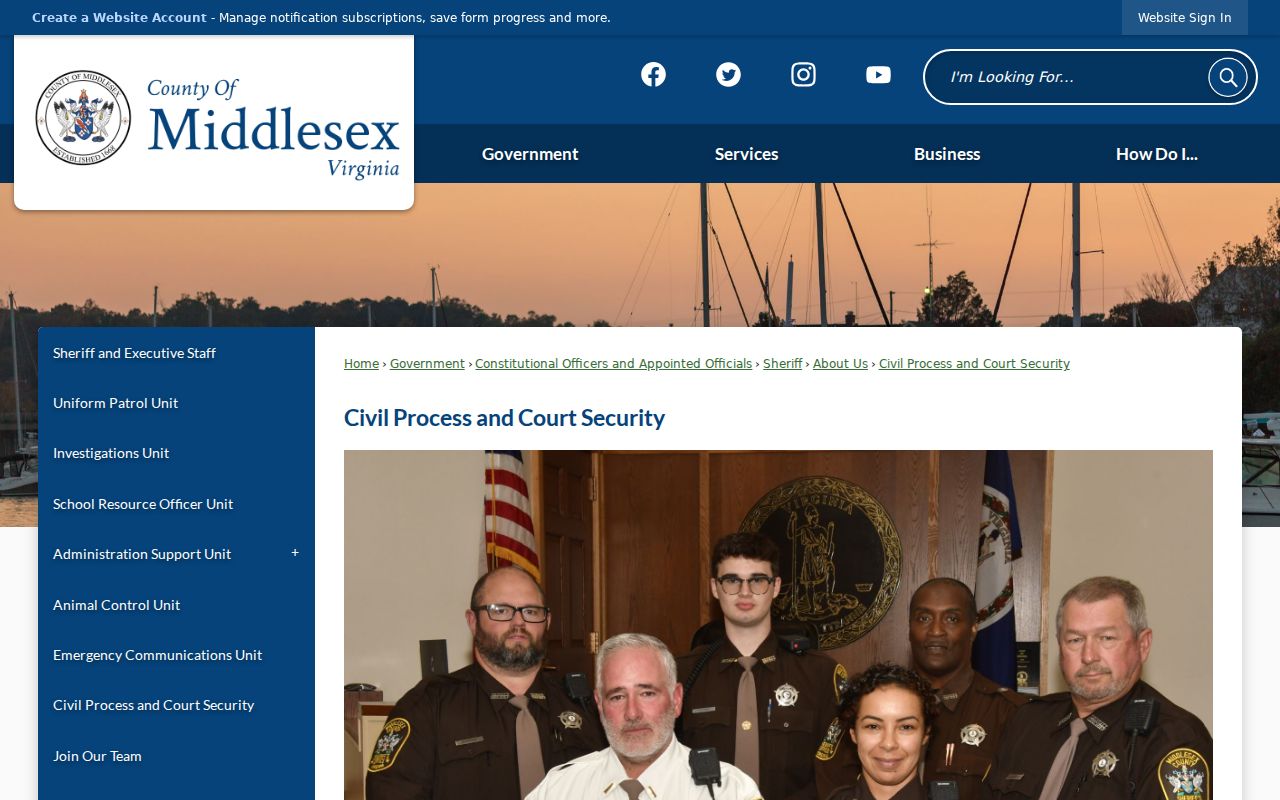
Call the clerk before bringing any device needed for research. No official source inspected published parking charges, lockers, or transit details, so those facts should not be assumed.
Criminal Records by City in Middlesex County
Urbanna is Middlesex County's only incorporated municipality. Saluda and Deltaville are important communities, but both are unincorporated and do not qualify for separate city pages under the project rule. A town-created record starts with Urbanna Town Hall. A Sheriff's Office or VSP report stays with the agency that created it. Adult custody goes to MPRSC, and court proceedings route through the Middlesex courthouse rather than a stand-alone Urbanna municipal court portal.
That split makes Urbanna's page useful without repeating the full county process. It explains the town-sergeant structure, town VFOIA route, regional booking path, and state court channels at the proper local level.
Urbanna Criminal History
Only incorporated town in Middlesex County, with Town Hall routing for town-created records.
Middlesex Criminal Court Search
Virginia Court Case Information separates General District, Circuit, and J&DR systems. Choose the system first, accept its terms, then select Middlesex. Search by full legal name or case number, with hearing-date routes available in some views. A felony can generate related district and circuit entries. “Certified” on the district side generally means the charge moved forward, not that a certified conviction exists.
The Virginia court case-information landing page shows the court-selection step. The image below reinforces why a county name alone is not a complete query.
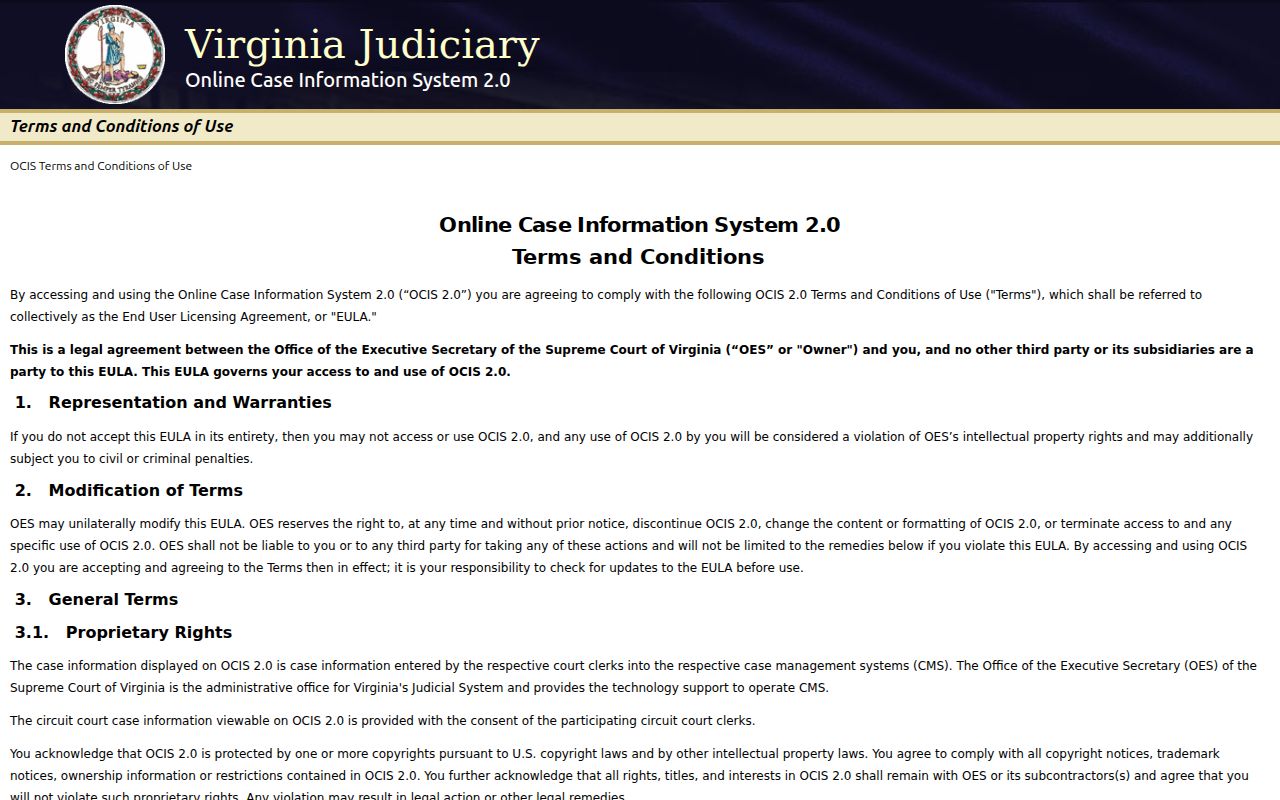
Read the final result with care. “Nolle prosequi” means the prosecutor chose not to continue that charge at that time. Dismissal and acquittal are outcomes, but neither statement alone proves that all arrest or repository records are inaccessible.
Middlesex Federal Criminal Records
Middlesex County lies in the Eastern District of Virginia. Federal court dockets therefore use PACER rather than Virginia's state case-information system. Federal custody uses the Bureau of Prisons locator rather than MPRSC or VADOC. For a subject-only national history, the FBI Identity History Summary requires fingerprints and is separate from both a federal docket search and Virginia SP-167.
The FBI electronic ordering portal supports the subject-only Identity History Summary process. Its captured interface below belongs to national self-review, not a general name search for another person.
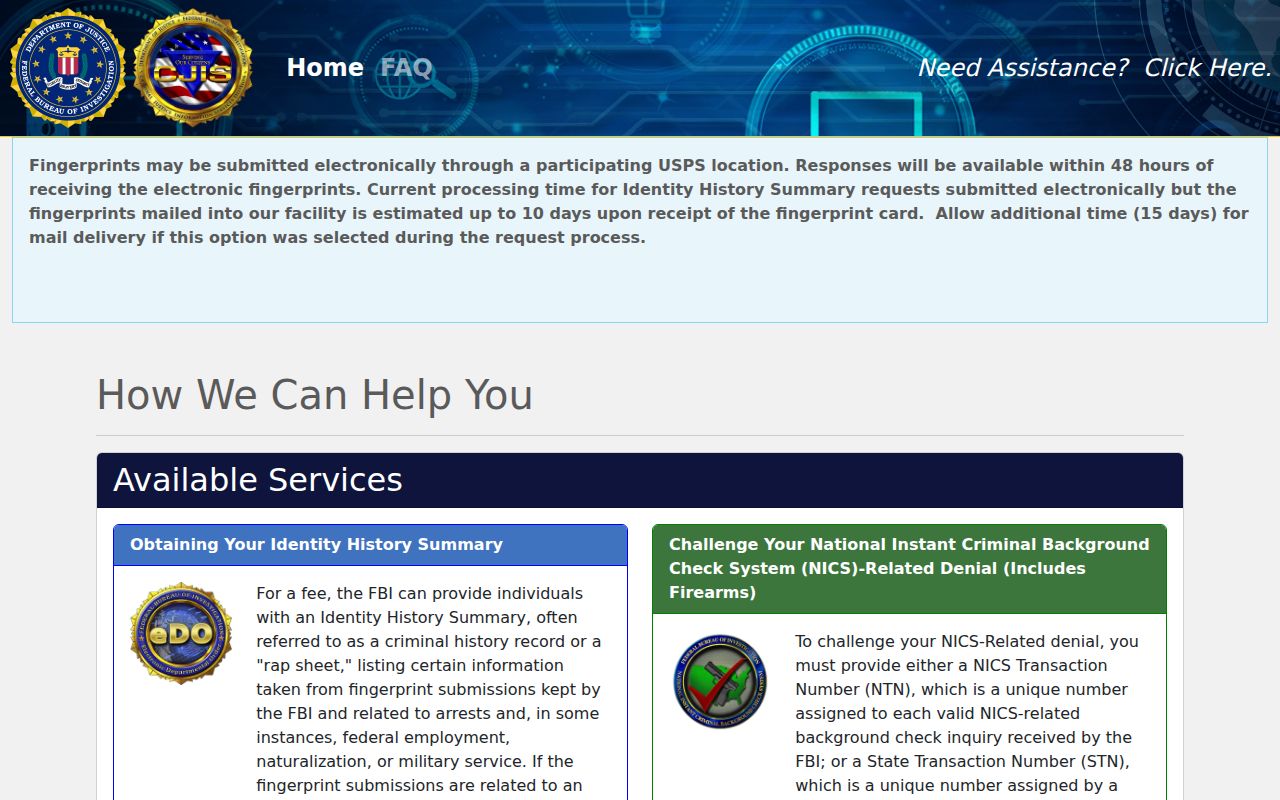
These boundaries prevent false gaps. An empty Virginia court result says nothing about a federal docket, and an FBI identity summary does not replace the local clerk's certified final order.